Ash Wednesday

www.journallive.co.uk

Ash Wednesday services at 9:30 am and 7:30 pm will be simple, spoken communion services.

You will hear the invitation to Lent and be invited to write down your own Lenten discipline(s). In an earlier email I suggested that you should look at these disciplines broadly. Whatever your personal Lenten discipline I hope that in the six weeks of Lent you will make a special effort to let your life be fed by the word and sacrament worship offered to you on Sunday morning, at Peace, or at some other church if you are traveling. The discipline of Sunday morning worship is the food and water of life for the Christian heart.

A ritual of Ash Wednesday is the imposition of ashes on our foreheads. The ashes are from last year’s palm branches. Imposed on your skin and skulls, the ashes are not an ancient ritual or a Catholic ritual (as some have told me over the years). Ashes on our foreheads remind each of us that we, along with every living thing around us, will die. The ashes remind us of the fleeting nature of our troubles and triumphs. The ashes remind us of the grace of Jesus Christ that follows us into the ashes of this mortal life. In the ashes, so to speak, is the most profound proclamation of the Christian gospel.

Ash Wednesday is the day of the great confession. In it we claim who we are. There is a great freedom and release in confessing who we are. In the Christian order of things, forgiveness follows confession.

Following the confession of Ash Wednesday comes a time of amendment of life, which is Lent.

We can do better. We can be kinder and more patient people. We can be more committed in our observance of our faith. We can be more charitable in our assessment of others. We can make better use of our time and of our resources. Lent invites us to turn to a few amendments of our lives.

Ash Wednesday is a day of foolishness. The ashes make us self-conscious.

Ash Wednesday is a curious observance to a death-denying secular culture. It is a strange observance to much of the church today, especially to Protestants–and, ironically, to much of the church throughout the Christian centuries–in it’s denial of death and its twin denial of the earth.

Christians need not keep an Ash Wednesday observance, but the day stands on our calendar with an offering to remind us of the limits of life and of the unlimited love of God. The two are known together.
Posted in Uncategorized | Leave a comment

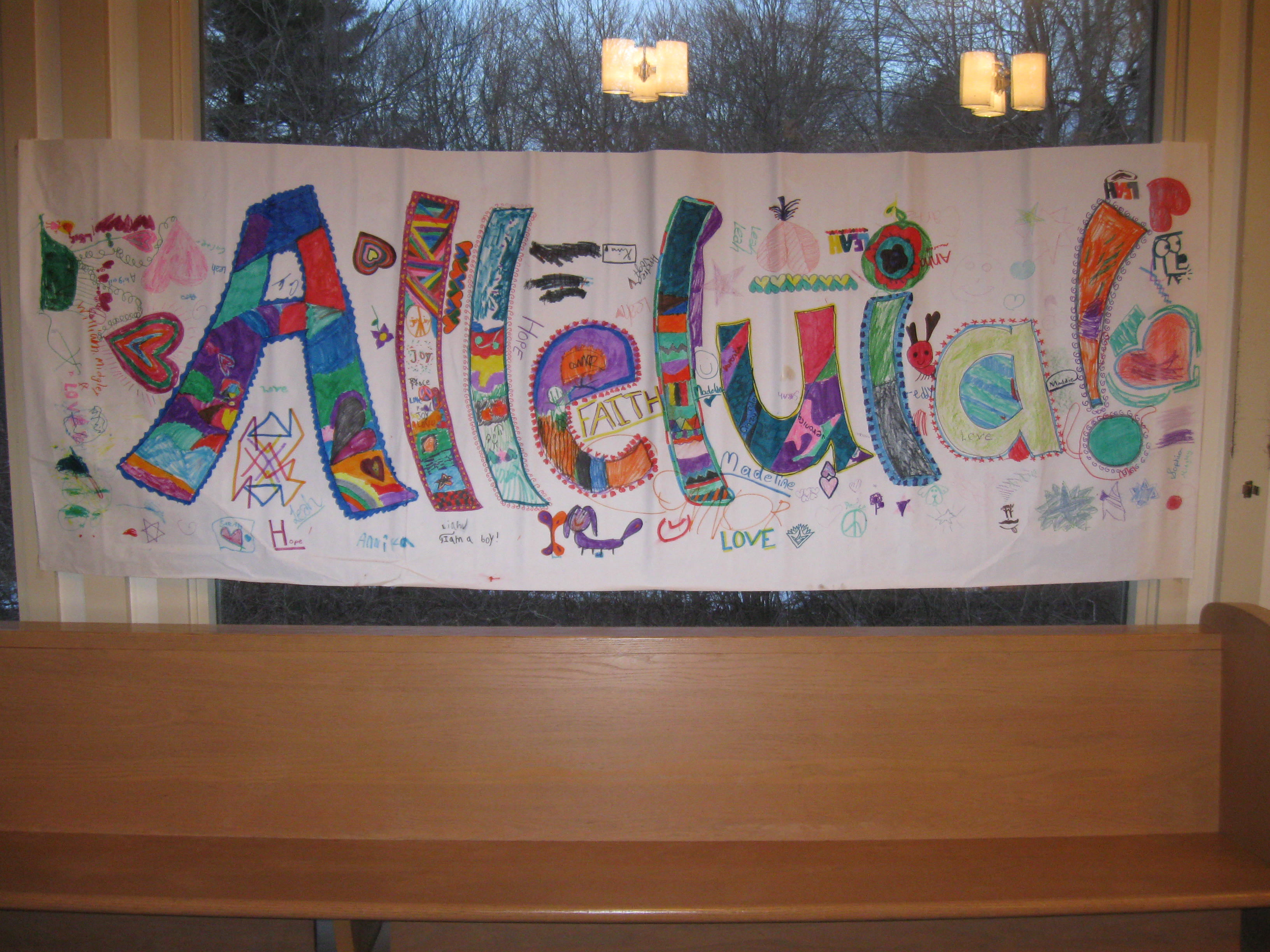
Sunday school Alleluia banner

002

Posted in Sunday school | 1 Comment

Transfiguration

The Transfiguration of Christ
The Transfiguration 16th Century Italian, Museum of Fine Arts Boston

Last week Nate and I toured a college. We were led down a wide hallway that opened into an atrium. In that space students milled and gathered and turned down other hallways or outdoors to the sidewalk. The Sunday of the Transfiguration, in Jesus life story, and in the liturgical year, is like an atrium. So much comes together, so many Old Testament themes, new adventures, healings, teachings, dramas, etc., that it becomes a blur of light. It’s almost as if the light is too much for us, so we turn to the quieter, reflective Lent to get our human bearings again.

I believe the snow will have cleared out by Sunday morning and we’ll gather in the light of sunshine on new snow. It will be a perfect setting for celebrating the Transfiguration.

Posted in Uncategorized | Leave a comment

Ash Wednesday and Lent

I hope that many of you will attend one of our Ash Wednesday services, and let it be for you a ritual beginning of the season of Lent. In other words, let the service be a ritual beginning to a more mature and deeper Christian faith. I hope as well that all of you will find a way to keep Lent in a way that fits your life.
 
Lent is the spring time, the planting time, of the Christian faith. Keeping Lent means planting yourself in the Christian life. Do this in a way that fits your unique, blessed interests and needs. For example, if you have always wanted to ______________, and that is a good and life-affirming thing to do, use the six weeks of Lent to begin __________________.
 
·         Read the Bible or read through the Small Catechism  (There are copies on the table in the narthex.)
 
·         Read a book, maybe a classic, that you have been meaning to read for some time.
 
·         Begin a hobby that has attracted you for years.
 
·         For the weeks of Lent avoid foods or beverages that distress you or compromise your activities—that make you fat or make you fall asleep, for example.
 
·         For the weeks of Lent make some other change in your diet that might help you live a healthier life or be a better resident of the planet: more local vegetables, for example.
 
·         Take time every day to speak to your children or to your parents.
 
·         Reach out to old friends.
 
·         Read aloud to someone in your house.
 
·         Take a walk every day.
 
·         Begin a service discipline or a prayer discipline.
 
·         Make a special Lenten offering to the church.
 
Your conscience has probably already told you what your Lenten discipline might be.  The possibilities are limited only by your imagination.
 
Make this Lent your season of spiritual growth; devise some marking of the season that makes a difference in your life.  Come to church every Sunday morning—or if you are away, find a church to attend—and renew your commitment to your Lenten discipline.
Posted in Uncategorized | Leave a comment

Jesus in Nazareth

In you, O Lord, have a I taken refuge;
let me never be put to shame. Psalm 71:1

The Gospel for Sunday is Luke 4:21-30. Jesus is still in his hometown, but he’s turned the locals against him with some unexpected words. God’s grace and love are for the stranger and the foreigner, the enemy and the outcast. When Jesus says this, the people of the village make the judgment that he is not one of them, so they take him out to the place of execution outside of town and try to kill him. Another episode of this village scene will happen outside the holy city of Jerusalem. There the people, with some help from the authorities, succeed in killing Jesus. In both scenes the people murmur and shout that he’s not one of us. He doesn’t play by our tribal rules. He doesn’t run with the pack; he seems to be under some other authority; his ideas and his actions upset us.

The promises of God-as delivered by Jesus- are for the outcast, the foreigner, the lonely, the excluded, the prisoner, the broken-hearted etc.: not for them as well as for the powerful,the secure and the enfranchised, but for them, period. I believe that this is one of the main messages of Jesus. It’s hard to wrap our minds around it, let alone try to run a human organization (the church) with that as the principle of operation. But there it is, I believe.

Posted in Uncategorized | Leave a comment

Jesus in the synagogue

 
 www.ellerman.org
He stood up to read, and the scroll of the prophet Isaiah was given to him. Luke 4:16
 
The Gospel reading for Sunday is Luke 4: 14-21. Jesus has come back to his hometown. He’s in the synagogue and is asked to be the guest speaker. He reads from the prophet Isaiah then makes a brief statement about his own purpose in life. He will fulfill the prophecy of Isaiah. He is the one anointed with the spirit to bring good news to the poor, release to the captives, freedom to the chained.
 
There we have our purpose as a congregation. We are Jesus’ troops, continuing his mission, carrying out his plan. On Sunday we will worship and then do a little planning of our own as we meet for our semiannual meeting.
 
In a note to some of our leaders who are preparing for the meeting I included a word about worship attendance and, further, about attendance in the worship room during the hour of worship. This lesson from Luke 4 is a good backdrop for asking that we attend as often as we can, and that when we are in the building we are in the worship room with everyone else.
 
There is a certain humility, reverence and respect for the rest of the community that is evident when we try to arrive more-or-less on time and sit quietly. We put our bodies and our minds in a position ready to learn, and to model for others, love of God and love of neighbor. I fully appreciate that this is not always possible, and I am aware of all the obligations and activities we juggle.
 
Anyway, here’s what I wrote earlier:
 
I would like us to try to avoid office work (kitchen and coffee hour work, Sunday school prep or anything else for that matter) while the service is going on. The hour of worship should be our community’s priority activity every week. I know that we may be tempted to steal time from church to get other important things done, but we need that hour together every week as a community of faith. Nearly everything else can wait one hour until the service is over or can be done Saturday or in another hour on another day of the week.
Posted in Uncategorized | Leave a comment

Wedding at Cana

Wedding at Cana

At noon today eight of us sat at tables in the fellowship hall. We heard an Epiphany devotion then talked together over lunch. Ruth shared pineapple; Mazie shared cookies. We heard jokes (a real howler from Doris) and stories about life, that passes all too quickly it seems to me. I always enjoy hearing memories and recollections of your life experiences.Sunday we will hear the second major Epiphany story, the wedding at Cana from John 2. Jesus is a guest and he changes water into wine. Just the kind of guest you want at a party. There is so much to mull over in this story. Marriage as a metaphor of the connection between God and Israel, marriage as the institution that does the magical thing of creating new people through the power of promises, marriage as the setting of hope and joy.

The forum Sunday morning during the Sunday school hour will be on distracted driving, especially texting.  Thanks to Donna for suggesting the topic and for leading the discussion.

Posted in Uncategorized | Leave a comment

Baptism of our Lord


Baptism of Christ

The Baptism of Christ  France 13th Century Museum of Fine Arts

This festival day is a singular moment in the New Testament. Along with the visit of the wise men and the wedding at Cana, it is one of the cornerstones of the Epiphany season. What does Jesus’ baptism mean? What does our Christian baptism mean? What does your baptism mean to you? Why was it important to you to have your children baptized?

The Protestant Reformers–with Luther first among them on this point–made baptism the home base in their “protests” against the medieval church. The priesthood of all believers would have been nonsense without the call to a Christian life given through baptism.

The liturgical movement of the last half of the 20th century was a “return to baptism”. This was viewed as an ecumenical emphasis, a common point of entry  into the Christian faith for all Christians, and a place to find further common ground through dialogue.  How does baptism work in the church today? Is there too much emphasis on baptism, on the “assembly of the baptized”, etc., or  too little attention paid to it?

Sunday we’ll think about the many meanings of baptism in the Christian church: a spiritual washing, a rite of passage, a ritual of the earth, a rebirth,  a sign of faith and devotion, a sacrament, an adoption, a sign of God’s love and unconditional acceptance.

Posted in Uncategorized | Leave a comment

Looking Back at Epiphany

ayay.co.ukWords of thanks to everyone who joined in the celebration of Epiphany on Sunday. A special word of appreciation to Mary Ann, Carol and Warren for working together at a number of tasks throughout the week, and when everyone else had gone home, to make the day a  success; to Kim Canning, the teachers, parents, and our wonderful kids, for presenting the Epiphany procession; to Stephanie and Veronica for creating the star; to all of you for working together on the potluck, for so willingly helping out before and after, and enjoying one another’s company. It felt to me like our congregation was in the zone as a family of faith on Sunday.

Posted in Uncategorized | Leave a comment

Sunday of the Epiphany

epiphany[1]

The nativity scene is complete on Sunday–the festival of the Epiphany-when the wisemen from the east arrive, late, of course. After all, they are wise men, and they think too much, take circuitous routes, take neat and detailed notes, They calculate and cogitate all the way to Bethlehem. (Recall that the shepherds dropped their staffs and ran when the angels announced Jesus’ birth.)

Jesus is not only a blessing to Israel, he is a light to the nations as well. Jesus is not only a blessing to the simple side of ourselves, the trusting, believing soul in each of us. He is a blessing to the skeptical, number-crunching, all-business side of ourselves as well. The wise men stand for people like us: the over-educated, over-scheduled, too-important types that we are, most of the time. Matthew tells us that the wisemen were overjoyed when they finally found Jesus. Then their spirits could rest. They bowed down and worshiped him, just as the shepherds did.

Epiphany has been loaded up with many meanings, shifting and evolving, over the years, in the Christian church east and west. This should not surprise us, since the characters of the wisemen are international, cross-cultural, and, as we like to say today, “diverse” and “inclusive”. We’ll hear about some of the traditions, customs and commemorations surrounding Epiphany on Sunday. Kim Canning will tell about some of the traditions of Epiphany from around the world, especially those involving children. Then our own children will help us “see” the wisemen, following the star, as we sing an Epiphany hymn.

In the relatively brief history of the Lutheran Church in the United States, Epiphany has been a season in which we emphasize world missions. Our ELCA has missionaries all around the world, serving people in the name of Jesus. Right after the service on Sunday we will ritualize this out-reaching part of the Christian message as we burn the Christmas greens. The light of Christ that warmed our hearts on Christmas Eve blazes out to the nations, and to the natural world, not with domination, new rules and commands (as it has so often done over the Christian centuries) but with deep humility and a spirit of service.

Remember that we will share a potluck lunch. Bring something to share. Kim has prepared an Epiphany activity for the children.

Posted in Uncategorized | Leave a comment