communion

Bread Stamp
(500-900 C.E.) Byzantium bread stamp was pressed into unbaked loaves to be used for the Eucharist. Jesus Christ Victorious. Metropolitan Museum of Art
At Peace we take turns bringing bread and wine for our weekly celebrations of holy communion. The ELCA manual on our liturgy says, “the bread may be leavenend or unleavened; the wine may be red or white”. Our normal practice is to use pita loaves and white wine. We pour a few glasses of purple grape juice for those who do not drink wine. Our long-standing practice of inviting members of the church to bring in the elements of communion–to prepare them for the sacrament and to carry them to the altar as gifts–says important things about the sacrament and about the nature of our local assembly.
Communion is the weekly reunion and spiritual meal of Christians. There is bread and wine, but these staples of tables around the world are ordinary and unremarkable without God’s word and your faith. The Gospel for Sunday continues the “bread of life” narrative from John 6. In it we understand that bread and a promise go together to make the sacrament: the flesh of human beings and the spirit of God are joined in holy communion. This is the central message of the Christian gospel, made visible and tangible every week in our holy communion.
When it’s your turn to bring the bread and wine on Sunday, and read the lessons, your Christian spirit inspires the rest of us on that day–your history, your hope, your faith. As you prepare the bread and wine, do it with joy and thanksgiving. When we receive it together at the altar, it will be the bread of life for the rest of us, the spirit of life within the gifts of bread and wine.

Posted in Uncategorized | Leave a comment
Virgin and Child with an Angel.  1400’s   Sandro Botticelli (Florence)    Gardner Museum
I am the bread of life that came down from heaven. John 6.  The devotional masterpiece, above, on display locally, illustrates the part of John’s Gospel that we are contemplating presently in church. The angel (registering a little bit of the tragedy of the story on his face) has wheat and grapes in his hands, gifts of God that become the means of grace in holy communion. Jesus identifies with the grain and the grapes; his body and blood will nourish the world in the bread and wine. The holy mother is the picture of peace and providence, actively approving of the whole arrangement. The child in her left arm will be the life of the world, symbolized by the wheat in her right hand.
We continue the bread of life narrations from John’s Gospel.  It’s Jesus in sharp exchange and conflict with the persistent crowd. They want bread for their bodies, and a sign–or proof of his divine power–Jesus wants to give them himself as the one who truly sustains human life.
People, all people, need guidance, hope, love, etc. Throughout John’s gospel, Jesus refers to himself as the one who is not only bread, but also light and truth and life. He fulfill’s God’s will and embodies God’s love. On Sunday we will look a little deeper at the way John picks up central symbols of human well-being and assigns them to Jesus.
Stay near Jesus, that’s my pastoral advice (as you well know). Listen to his words, repeat them and ponder them, receive Jesus into your body in the sacrament of the altar.

Posted on by Peace Lutheran Church Wayland Massachusetts | Leave a comment

worship

Get back to work! the disciples seem to be saying to Jesus in the gospel reading for Sunday (Mark 1:29-39). Jesus spends a day doing extraordinary things. Then, before the first light of the next morning, he steps away from that work to pray. The disciples track him down and try to impress upon him how much he is needed by the people, for more healing. There are still sick and suffering people. They keep appearing. Jesus needs to heal, heal, heal. Drive out those demons and keep the people happy. He’s got a gift so he needs to use it! Right?

Trusting in our selves and in our ambitions, in our conclusions and in our decisions, as the final judgements on our lives is within a few short steps of what Christian theology calls sin. We’ll go over this again on Sunday. Through our faith, sin melts from our lives, and we accept our unconditional acceptance by God, all our successes and failures, work and worry notwithstanding. In other words, the Christian Gospel for you is that you are loved, as a person, prior to anything you do, think or say, or fail to do, think or say.

With this thought we come to an important Christian teaching, deep in the season of Epiphany: Your value and worth do not depend on what you do, and not on what you achieve or accomplish, and not on what you fail to do, or forget to do, or do poorly or half-heartedly. Through Christ you are forgiven, everything, even what you still want to brag about. Faith drops all claims and pretentions and accepts unconditional acceptance by God through Jesus Christ.

The “work” of our liturgy (which, paradoxically, is our “rest”) includes confession, then reception of a life-giving word that restores our inner hearts, followed by prayer in which our new selves reach out beyond our personal and immediate concerns. Through the therapy of the liturgy we are healed and restored to our true selves. Each liturgy could be the occasion of an “epiphany” or re-discovery of our true self, acceptable and accepted, loved and freed from all the world’s expectations.


Posted in Uncategorized | Leave a comment

prayer

As he went ashore, he saw a gread crowd; and he had compassion for them, because they were like sheep without a shepherd; and he began to teach them many things.  Mark:6:34
Sometimes my father kept sheep in the pasture around our house. I believe they must have been old animals that a local farmer sold to him. My father liked having sheep around, and so did I. He would hire a man to shear them. My brothers and I would help out by herding them into a corner and catching them. On hot summer days, the sheep would find a corner of shade and stand very still and close together, shading one another with their bodies.
As we face the heat of midsummer, we remember the farmers suffering in a drought in the middle of the country. We have all been horrified by the shooting in Colorado. As Christians we respond to those who suffer by sending aid and through the the spiritual shade of prayer.  The prayers shade us all, people of prayer.Prayer is our distinctive Christian activity.
If you say, or someone you know, says, what good is prayer, the answer to that reasonable question is long and slow, like a summer afternoon, way too long for a short paragraph. One might begin by telling what prayer is not: prayer is not a technology, not an application of knowledge; prayer is not a therapy; prayer is not power. If you read these through you understand why secularists and most of us–brainwashed by secular ways of thinking–say, then why pray? What’s the use of praying?
Prayer might be of no use, if we mean by use that prayer must produce something or cause some predictable or noteable effect. It might be of no use if we assume that our prayers have failed if what we pray for fails to happen. (The second petition of the Lord’s prayer–thy will be done–is the guard against the kind of prayer that is directed toward some outcome.)
Prayer is presence, spiritual presence with those who are not with us, with those who suffer, with those we love, with those from whom we are estranged, with the world. Prayer is communion and a special kind of attention, paid in the name of Jesus.
Prayer, for us, is of utmost importance. When we are in prayer, we are showing our true identity as Christians. Every other thing that we do or hope to do–as Christians–is an outcome of prayer. Simone Weil said that prayer is “attention in its purest form”. When a Christian says, I’ll pray for you, she/he means by this, at least: I will remember you, think about you, hope the best for you, not forget you, etc. Attention in its purest form. Jesus paid attention to people. When we pray, we pray in his name, because his attention was so impressive that it is “everlasting”. The healing that he did, that meant so much to such as the Evangelist Mark, is the result of his focused attention on people and their trouble.
Posted in Uncategorized | Leave a comment

Christmas

On Christmas the family gathers to sing and pray and receive holy communion. Those who belong to Jesus return to their Christian family home to reflect on the life-renewing meaning of the gospel of the nativity. The muscular Christian message of Christmas (distinct from the culture’s soft and soupy mix) means that walls of separation shall be broken. Borders that separate people from one another shall be crossed and then erased from the landscape. Lion and lamb, rich and poor, old and young shall see themselves in one another’s eyes. Philips Brooks wrote in his pilgrimage-inspired hymn, O Little Town of Bethlehem: “O holy child of Bethlehem, be born in us we pray…”  The Christmas gospel does not mean merely that Jesus was born in Roman-ruled Palestine, but rather that Jesus is born in us, spiritually and truly, giving us new eyes and new hearts with which to go forward through our lives. These are the real, priceless, Christmas gifts.

Remember, tomorrow night, when you are weighed down and groggy with fancy food and drink, struggling through half-remembered customs, dizzy with high and burdensome expectations, that Jesus belongs to you, and you belong to Jesus.

Through faith he offers you a night of peace and cleansing freedom from everyone else’s expectations, including your expectations of yourself. He offers you new hopes and dreams and real reasons to celebrate. He makes your spiritual heart soar as if you had been born again.

In other words, remember that you are not a Christmas spectator. You are a member of Jesus’ family. Your place is in the assembly where Jesus’ family gathers in his name every week.  A place always awaits you at the table of grace where, with your brothers and sisters in Christ, you receive your Savior, Christ the Lord.
Posted in Uncategorized | Leave a comment

communion, confirmation, stewardship

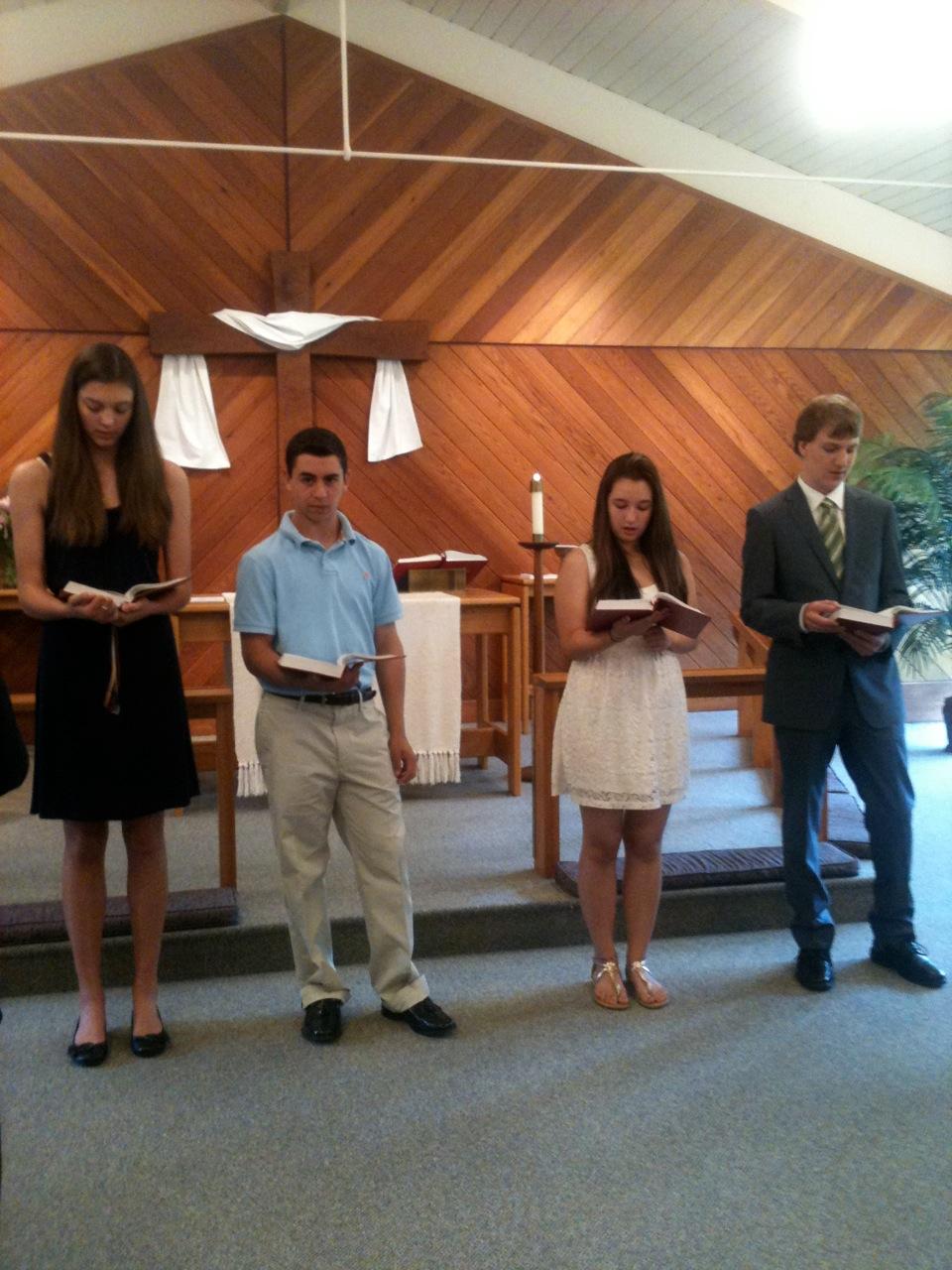
In the coming weeks I will make a special effort to explore the meaning of three key teachings of the Christian church—communion, confirmation and stewardship—bringing out teachings from the lessons for the day. These three marks of the church are related in a weave of belonging and learning.  The gospel of Jesus Christ calls people together into local communities in which a distinctive set of ancient teachings about the meaning of life, as well as certain expectations with regard to behavior and ethics, are recalled and interpreted for their lives. As a member of a Christian congregation you have agreed to do certain things (such as attending church services) and then to think about certain biblically-based assertions about the world (such as the statements summarized in the creed). You are not expected to believe everything you hear but you have agreed to be engaged with the claims the Christian faith makes on your life and the promises offered therein. Note that as heirs of the Reformation heritage we may never say that a vigorous questioning of orthodox Christian teaching is not allowed. We are not in the business of policing spiritual lives.All members of the church, of all ages, are involved in each of these ministries. Confirmation is not for high school students alone; first communion is not for second graders only; stewardship is not merely adult talk about money. The young people look to the older members as mentors and models of faithful living; adult members keep the younger ones in mind as they live out their Christian life and support the church. Here are some preliminary thoughts.

First Communion
After our young elementary age children have received instruction in the meaning of Holy Communion they are invited into the silent, reverent reception of bread and wine, accepted through faith as the body and blood of Christ. At the altar we quiet our minds and our hearts for a moment and receive the gift of life.  Outward stillness of our bodies and quiet reception of the bread and wine helps others be similarly still and quiet. At an early age of understanding, we point out this basic church “table manner” and mark a child’s first communion.Our confirmation students have taken part in the younger students’ preparation. They will play a role on the day first communion.

Confirmation
Confirmation students continue their Sunday morning instruction in the Christian faith. Chris Toomey is their teacher. In addition they will meet Sunday afternoons at 3 pm to explore the meaning of the Christian faith in the context of the world around them. When we leave the service every Sunday morning the assisting minister for the day says, Go in peace, serve the Lord. In our confirmation classes we will explore a little bit of what that might mean as we walk on conservation trails, visit local farms, art museums and religious buildings belonging to people of other faiths. The Christian faith has profound give-and-take outside the walls of the church. The eyes of faith see the world in a different light. The world has its own way of teaching and shaping a Christian’s faith.
Stewardship
We have been working on expanding our idea of stewardship as a Christian way of life. We still want the word to mean caring for and paying for the maintenance and operation of the congregation’s home and its operations, but we know now that stewardship means much more than that. The word stewardship is one of those elastic terms that expands to take in nearly all the aims of a Christian life: It means caring for the natural world around us, using the earth’s resources wisely, caring for one another as human beings, caring for the wisdom of our faith by attending church and learning, looking out for our young people by providing for their instruction in the Christian faith, etc. This last example is the job of all  members of the congregation, as we model the Christian faith for our young people, and they refresh our appreciation of it with their insights and enthusiasm.
Posted in Uncategorized | Leave a comment